Buying guide · Updated 2026
Best 88-Key Weighted MIDI Controllers Under $500
Four 88-key controllers under $500: hammer action from M-Audio and Arturia, a semi-weighted option with a full control surface, and a budget board for piano-style practice. For pianists moving into production, this category decides how it feels.
How we picked
- 1. Keybed action is 70% of the decision at this price
- 2. Pedal inputs: sustain, soft, and sostenuto support matters for piano practice
- 3. DAW control only counts when the keybed already delivers
- 4. MIDI 5-pin out for connecting to hardware synths and stage modules
88-Key Weighted Controllers at a Glance
| Controller | Keys | Pads | Knobs | Faders | DAW Deep | Price |
|---|---|---|---|---|---|---|
M-Audio Hammer 88 Best 88-Key Value | 88-key hammer | — | — | — | Universal; class-compliant, no DAW presets | $479Full review → |
Arturia KeyLab Essential 88 Best Overall | 88-key hammer | 8 | 9 | 9 | Ableton Live, Logic, FL Studio, Cubase, Studio One | $499Full review → |
Nektar Impact LX88+ Best Control Surface | 88-key semi-weighted | 8 | 9 | 9 | Reason, Cubase, Logic, FL Studio, Studio One | $299Full review → |
Alesis Q88 MkII | 88-key synth | — | — | — | Universal; class-compliant | $249Full review → |
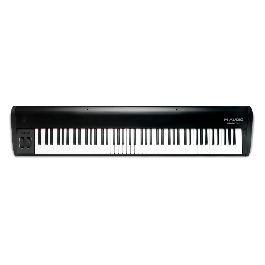
M-Audio Hammer 88
A no-frills hammer-action 88 with a graded keybed and every pedal input a pianist needs. No knobs, no pads; the whole budget went into the keys.
- ✓Genuine hammer-action graded keys at the best price in its class
- ✓Three pedal inputs (sustain, soft, sostenuto capable)
- ✓5-pin MIDI out for gigging with older sound modules
- -No pads, knobs, or faders at all
- -No onboard sounds; controller only
- -Larger footprint than most 61-key setups
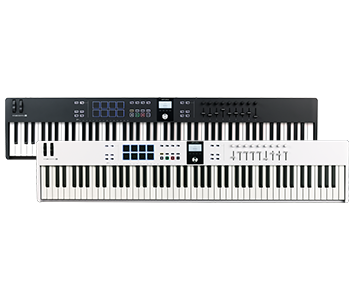
Arturia KeyLab Essential 88
Hammer-action keys with the Essential 49's DAW control: pads, faders, knobs, transport, and Analog Lab Pro. The most complete 88 under $500.
- ✓Fully weighted keys plus 9 faders, unusual under $500
- ✓Same deep DAW presets and Analog Lab Pro bundle as the 49
- ✓Chordable scale modes make composition approachable
- -Keybed action is good, not grand-piano great (expected at $499)
- -Heavy; plan where it lives
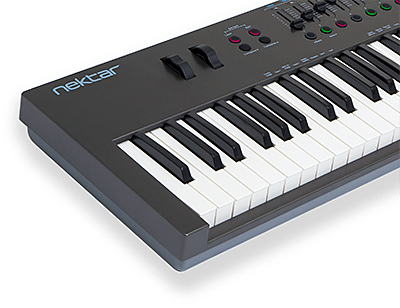
Nektar Impact LX88+
The most complete 88-key package under $300: semi-weighted keys, eight pads, nine faders, nine knobs, and one-cable DAW mapping.
- ✓Pads, faders, knobs, and transport on an 88-key board; no other in this guide comes close
- ✓Nektar's DAW integration maps everything automatically in all majors
- ✓Light weight for an 88-key board
- -Semi-weighted action, not hammer; pianists should look at the Hammer 88 or KeyLab Essential 88
- -USB only; no 5-pin MIDI for hardware rigs
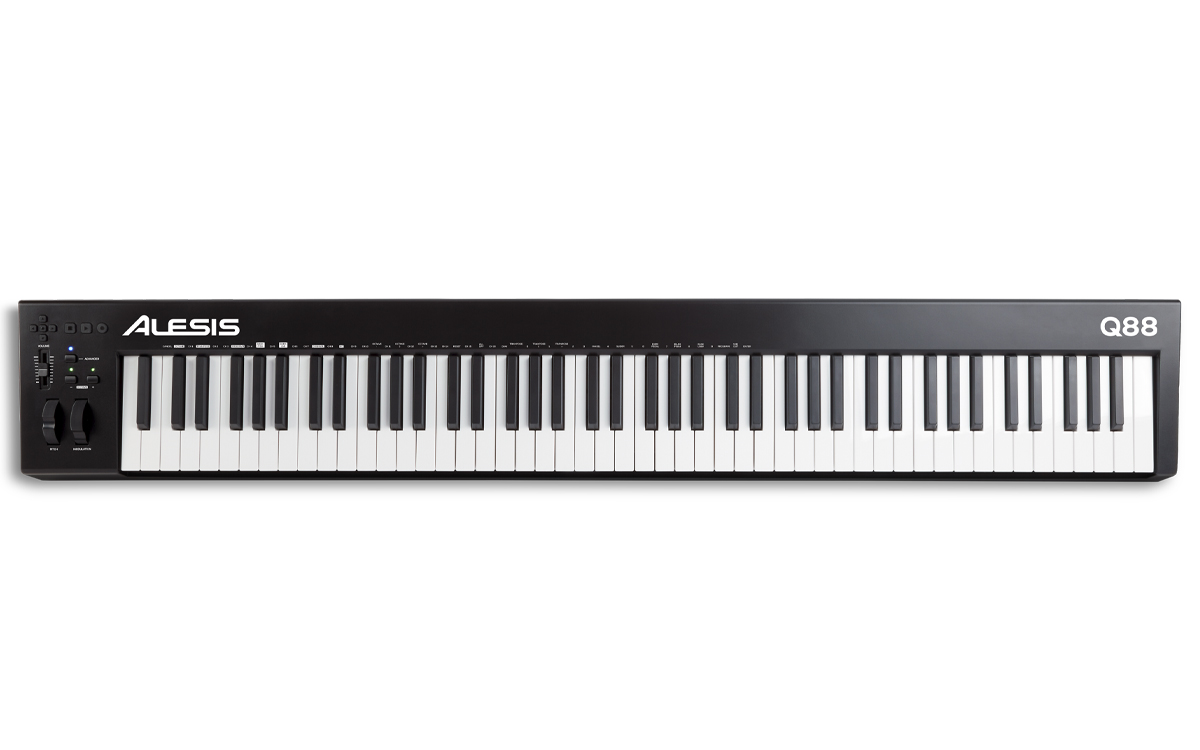
Alesis Q88 MkII
An 88-key budget workhorse: synth-action keys and a full range for software lessons and chord-heavy production on a small budget.
- ✓Hundreds less than hammer-action rivals
- ✓USB-powered, class-compliant, zero driver friction
- ✓Simple pitch/mod wheels
- -Light synth action, not true hammer feel
- -No pads, knobs, or transport
- -Large and light-feeling plastic chassis
Where the money goes
Under $500 there is a hard trade-off: keybed quality versus control surface. The Hammer 88 spends its entire budget on the action, which is the right call for pianists. The KeyLab Essential 88 splits the difference and adds faders, pads, transport, and a full software bundle. The Nektar Impact LX88+ goes furthest on control surface: eight pads, nine faders, and nine knobs around a semi-weighted 88-key bed.
Buy the Hammer 88 if you want the cheapest honest hammer action and plan to control your DAW with the mouse. Buy the KeyLab Essential 88 if you want one box that does piano and production. Buy the Nektar LX88+ if pads, faders, and knobs matter as much as the keys. Buy the Q88 MkII only if 88 keys matter more than the action.
Frequently Asked Questions
Is a weighted 88-key worth it if I make electronic music?
Only if you actually play piano-style parts. Weighted actions shine for chord voicings, expressive dynamics, and practicing piano technique. If your music is drums, basslines, and synth leads, a 49- or 61-key synth-action controller is lighter, cheaper, and easier to place on a desk. The money is better spent on sounds or monitors.
Hammer action vs semi-weighted: what is the difference?
Hammer action uses graded internal hammers so the keys feel heavier in the bass and lighter in the treble, like an acoustic piano, and the keys return under real weight. Semi-weighted keys are spring-loaded with added mass: a middle ground that feels sturdier than synth action but does not replicate a piano. If you practice piano repertoire, get hammer action.
Do I really need all 88 keys?
Only for piano repertoire that uses the full range. Most modern music rarely goes below the 49-key range, and 61 keys cover almost everything. Buy 88 keys when the controller doubles as your piano practice instrument, not because more keys feel more serious.
Will a MIDI controller feel like my acoustic piano?
Close, but not identical. Hammer-action controllers in this price range are graded and touch-sensitive, and most pianists adjust within a session. The action is lighter and the sound is whatever software you load. If you want the closest possible feel, the M-Audio Hammer 88 has the pick of the group for graded hammer action.
The bottom line
The M-Audio Hammer 88 is the value answer and the KeyLab Essential 88 is the complete answer. The Nektar LX88+ is the control-surface king for producers who insist on 88 keys.